.png)

Why Systems Thinking Is Becoming a Competitive Advantage for Modern Lenders?

Get In Touch
.png)
Heading 1
Heading 2
Heading 3
Heading 4
Heading 5
Heading 6
Lorem ipsum dolor sit amet, consectetur adipiscing elit, sed do eiusmod tempor incididunt ut labore et dolore magna aliqua. Ut enim ad minim veniam, quis nostrud exercitation ullamco laboris nisi ut aliquip ex ea commodo consequat. Duis aute irure dolor in reprehenderit in voluptate velit esse cillum dolore eu fugiat nulla pariatur.
Block quote
Ordered list
- Item 1
- Item 2
- Item 3
Unordered list
- Item A
- Item B
- Item C
Bold text
Emphasis
Superscript
Subscript
For decades, lenders have focused on optimizing individual functions across the lending lifecycle. Credit teams work to improve underwriting quality. Operations teams focus on reducing turnaround times. Collections teams aim to maximize recoveries. Technology teams automate processes and improve efficiency.
While these efforts are important, many lenders continue to face a common challenge: improving individual functions does not always translate into better business outcomes. A lender may achieve record disbursement volumes only to see delinquency rates increase months later. Collections performance may improve, yet customer retention may decline. Technology investments may automate processes, but operational bottlenecks continue to exist. These situations often occur because lending organizations are viewing performance through the lens of individual departments rather than understanding how every decision influences the broader lending ecosystem.
This idea sits at the heart of The Fifth Discipline by Peter M. Senge. The book introduced the concept of systems thinking, a discipline that encourages organizations to understand relationships, patterns, and interconnected outcomes rather than focusing solely on isolated events.
While originally developed as a management philosophy, systems thinking has become increasingly relevant for modern lenders navigating digital transformation, changing borrower behavior, rising compliance expectations, and growing competitive pressure.
The reality is that lending has always been a system. Every loan that enters a portfolio is influenced by a chain of decisions made across multiple functions. Borrower acquisition impacts credit quality. Underwriting decisions influence future collection efforts. Servicing experiences affect customer retention and cross-sell opportunities.
.png)
Portfolio monitoring influences risk mitigation strategies. None of these activities operate independently. They are interconnected parts of a larger ecosystem that ultimately determines the health and profitability of a lending institution.
One of the biggest challenges facing lenders today is the persistence of operational silos. Most institutions are structured around specialized functions, which is necessary from an organizational perspective. However, when each department focuses exclusively on its own objectives, unintended consequences often emerge elsewhere in the business.
Consider a lender attempting to accelerate growth in a competitive market. To improve approval rates and increase disbursements, underwriting policies are adjusted to accommodate a wider borrower base. In the short term, the strategy appears successful. Loan volumes increase, acquisition costs improve, and business targets are achieved.
Yet six months later, collection teams begin experiencing higher delinquency rates. Recovery costs increase, portfolio quality starts to weaken, and risk teams are forced to tighten controls.
Conversely, a credit team may implement stricter underwriting standards to reduce risk exposure. While this may improve portfolio quality, it can also reduce customer acquisition rates, increase abandonment during onboarding, and impact revenue growth. Neither decision is inherently wrong. The issue lies in evaluating outcomes in isolation rather than understanding their impact across the lending ecosystem.
This is precisely why systems thinking is becoming such a valuable capability for lenders. Instead of asking whether a single process is performing well, systems thinking encourages leaders to examine how decisions made today influence future outcomes across the organization. It shifts attention from individual activities to the relationships between activities.
The importance of this approach has increased significantly as lending environments become more complex. Borrowers now expect seamless digital experiences and near-instant decisions. Regulatory expectations continue to evolve. New data sources are changing how risk is assessed.
Economic conditions can shift rapidly due to geopolitical events, supply chain disruptions, inflationary pressures, or sector-specific downturns. In this environment, lenders can no longer afford to view risk, growth, compliance, and customer experience as separate priorities. Each affects the others.
A growing number of successful lenders are recognizing that sustainable growth depends not only on operational efficiency but also on their ability to understand the interactions that drive portfolio performance. They are moving beyond departmental reporting and adopting a more holistic perspective on decision-making.
This shift is particularly important when it comes to data. Most lenders today have access to vast amounts of information. They can analyze bureau reports, repayment histories, transaction patterns, customer interactions, collection activities, and operational performance metrics. Yet having access to data does not automatically lead to better decisions.
Many organizations still use data primarily for reporting. Systems thinking encourages a different approach. Instead of simply measuring outcomes, lenders begin exploring the relationships behind those outcomes.
Rather than asking why collection efficiency declined last month, they investigate whether borrower acquisition channels, underwriting changes, product structures, or servicing experiences contributed to the trend. This ability to connect signals across the lending lifecycle transforms data into portfolio intelligence.


The concept of the learning organization, another central theme in The Fifth Discipline, further strengthens the case for systems thinking in lending. Learning organizations continuously adapt by observing patterns, questioning assumptions, and incorporating feedback into decision-making. They understand that success is not achieved through static processes but through continuous learning and improvement.
This mindset is becoming increasingly important for lenders because the market itself is constantly evolving. Borrower expectations are changing. Digital channels are becoming dominant. Regulatory frameworks continue to expand. New technologies such as artificial intelligence, alternative data analysis, and embedded finance are reshaping competitive dynamics.
Organizations that rely solely on historical practices often struggle to respond effectively to these changes. In contrast, learning organizations treat every outcome as valuable feedback. They seek to understand not only what happened but why it happened. They identify patterns before problems become visible. They use insights to refine credit strategies, optimize collection efforts, improve customer experiences, and strengthen risk management practices.
Importantly, systems thinking also challenges a common misconception about digital transformation. Many lenders view transformation primarily as a technology initiative. They invest in automation, workflow engines, mobile applications, and digital onboarding platforms. While these capabilities are important, technology alone cannot eliminate organizational silos.
True transformation occurs when technology connects functions across the lending lifecycle and enables teams to operate from a shared understanding of the business. The greatest value is not simply automating individual processes. It is creating visibility across the entire borrower journey so that decisions can be made with full context.
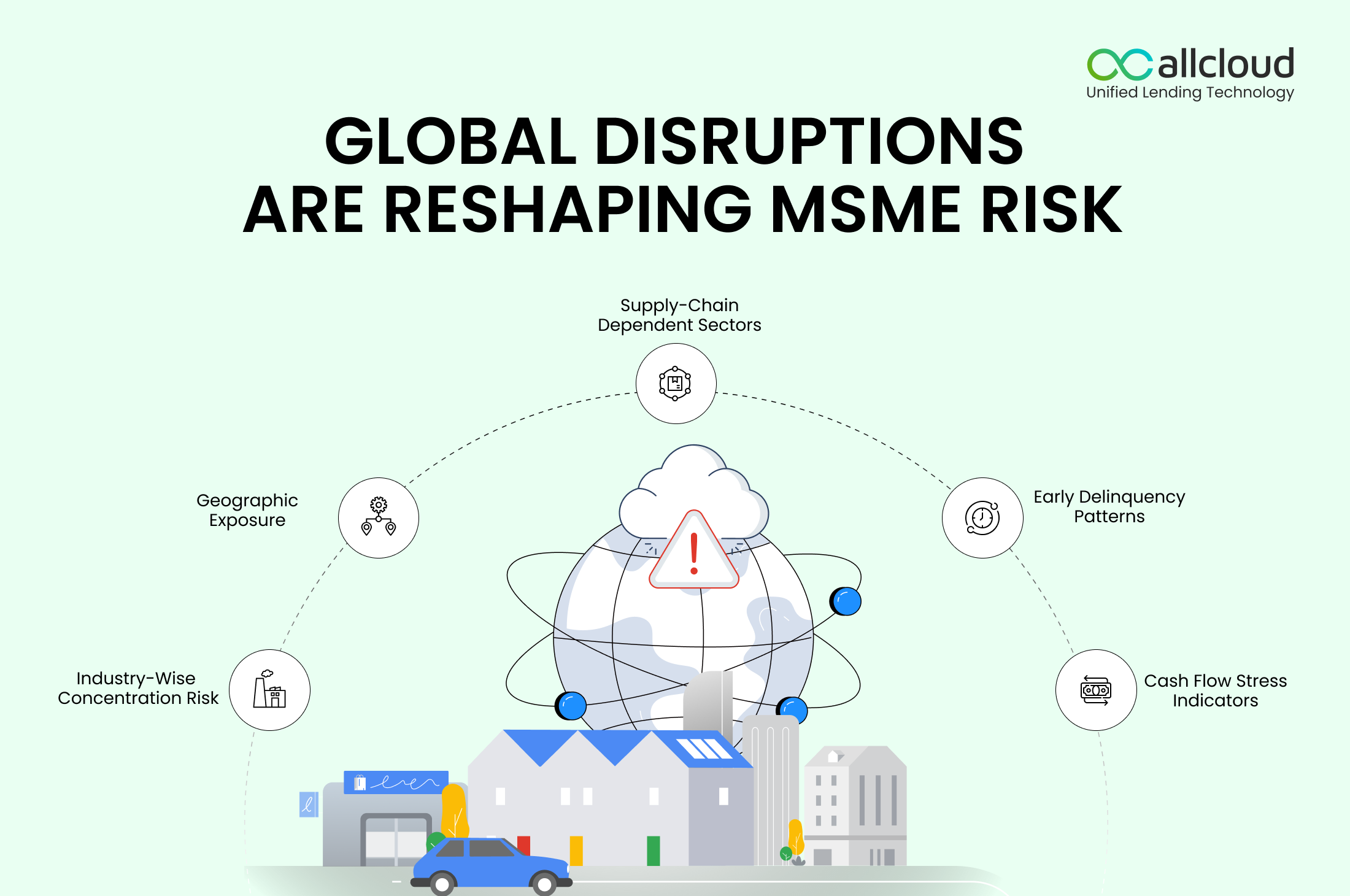
This is particularly relevant in risk management. Modern risk is no longer confined to individual borrowers. Portfolio risk is increasingly influenced by external factors such as economic volatility, geopolitical developments, climate-related disruptions, sector-specific stress, and changing consumer behavior. These risks rarely emerge as isolated events. They spread through interconnected systems.
A systems-thinking lender is better equipped to recognize these relationships early. Instead of reacting after delinquency rates rise, they can identify warning signals across borrower segments, industries, geographies, and products. They can evaluate portfolio exposure more effectively and respond proactively rather than reactively.
As lending continues to evolve, the institutions that will outperform are unlikely to be those with the most departments, the largest technology budgets, or the most complex processes. They will be the organizations that understand how every part of the business contributes to a shared outcome.
This is ultimately the lesson that The Fifth Discipline offers modern lenders. Competitive advantage is no longer created by optimizing isolated functions. It is created by understanding how the entire system works together. For lenders seeking sustainable growth, stronger portfolio quality, improved operational efficiency, and better customer experiences, systems thinking provides a powerful framework for navigating complexity. It encourages organizations to move beyond short-term metrics and focus on the interconnected relationships that shape long-term performance.
This philosophy is increasingly reflected in the technology choices lenders make. As organizations seek greater visibility and control across the lending lifecycle, many are moving toward unified platforms that connect origination, servicing, collections, analytics, and portfolio management within a single ecosystem.
AllCloud's Unified Lending Technology Platform is built on this very principle. By connecting Loan Origination, Loan Management, Collections, Customer Self-Service, and Analytics into one integrated environment, AllCloud enables lenders to break down operational silos and gain a comprehensive view of their lending ecosystem. Instead of managing fragmented processes across disconnected systems, lenders can make decisions based on complete portfolio visibility and real-time insights.
In a world where lending outcomes are increasingly influenced by interconnected decisions, systems thinking is no longer just a management concept. It is becoming a strategic advantage. And for modern lenders, the ability to understand and improve the system as a whole may be one of the most important capabilities for long-term success.
.svg)