.png)


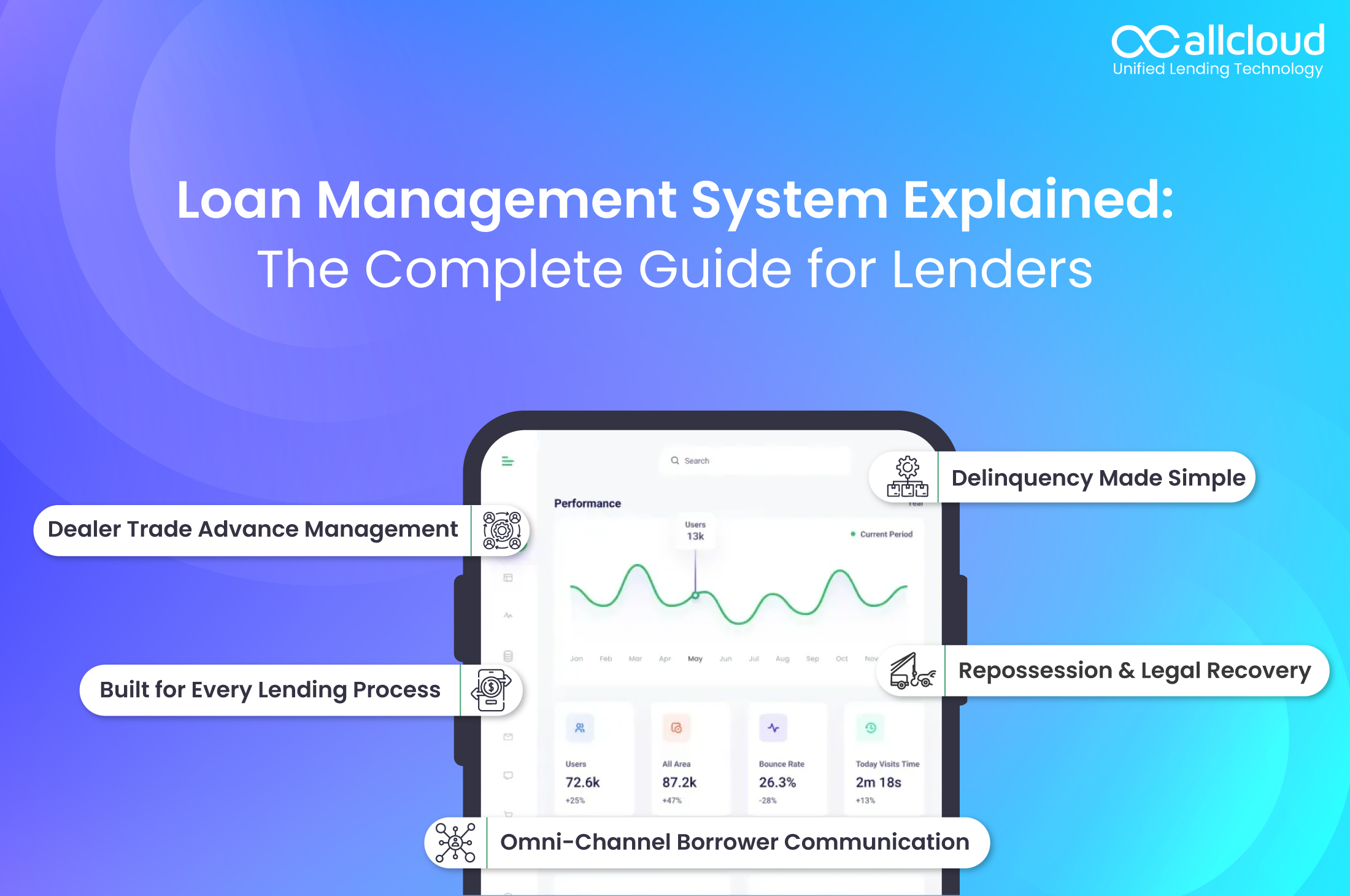
What Is a Loan Management System? How It Works for NBFCs and Banks in India

Get In Touch
Heading 1
Heading 2
Heading 3
Heading 4
Heading 5
Heading 6
Lorem ipsum dolor sit amet, consectetur adipiscing elit, sed do eiusmod tempor incididunt ut labore et dolore magna aliqua. Ut enim ad minim veniam, quis nostrud exercitation ullamco laboris nisi ut aliquip ex ea commodo consequat. Duis aute irure dolor in reprehenderit in voluptate velit esse cillum dolore eu fugiat nulla pariatur.
Block quote
Ordered list
- Item 1
- Item 2
- Item 3
Unordered list
- Item A
- Item B
- Item C
Bold text
Emphasis
Superscript
Subscript
If you are running a lending business whether an NBFC, bank, microfinance institution, or digital lender the term Loan Management System (LMS) comes up constantly. But what exactly is it, what does it do, and why does it matter for your operations?
This guide covers everything you need to know: the definition, core features, how it works, who needs it, and what to look for when evaluating one.
What Is a Loan Management System? A Complete Guide for Lenders
It is a Cloud based platform that manages the complete lifecycle of a loan after it has been disbursed. It is the operational backbone of a lending business centralising everything from EMI tracking and collections to compliance reporting and borrower communication in one place.
In simple terms: once a loan is approved and funds are transferred to the borrower, the Loan Management System takes over. It tracks repayments, calculates interest, flags overdues, manages collections, handles restructuring, and generates the reports lenders need to stay compliant.
A Loan Management System is not just a tracking tool it is a system of record for every action taken on every loan in your portfolio.
Looking for a solution? Explore allcloud's loan management system built for modern lenders.
Loan Management System vs Loan Origination System, What is the Difference?
These two are often confused. Here is the key distinction:
- Loan Origination System (LOS): Handles everything before disbursement application intake, credit assessment, underwriting, approvals, and disbursal.
- Loan Management System (LMS): Handles everything after disbursement repayments, EMIs, collections, delinquency, restructuring, and closure.
Many modern lenders use both systems as part of a unified lending platform. Together, they cover the full loan lifecycle from application to closure.
How Does a Loan Management System Work?
A Loan Management System operates through a structured workflow that mirrors the post-disbursement loan lifecycle:
- Loan account is created with agreed terms, interest rate, repayment schedule, and collateral details
- EMI schedule is generated automatically based on loan amount, tenure, and interest method
- Repayments are collected and allocated across principal, interest, penalties, and charges
- System detects overdue accounts and triggers automated borrower communications
- Collection steam is alerted with bucket-wise delinquency classification
- Escalation workflows are triggered for recovery, legal action, or restructuring
- Compliance reports and MIS are generated in real time
- Loan is closed, written off, or renewed based on account status
Every step in this workflow is logged, auditable, and controlled giving lenders complete operational visibility.
Core Features of a Loan Management System
Not all loan management software is built the same. Here are the core features you should expect from an enterprise-grade system:
1. Automated EMI and Repayment Scheduling
The system generates accurate repayment schedules based on loan type, tenure, interest method (flat, reducing balance, IRR), and special conditions. This eliminates manual calculations and reduces errors.
2. Collections and Delinquency Management
A robust LMS tracks over dues in real time, classifies them into delinquency buckets (DPD 0-30, 30-60, 60-90, 90+), and automates borrower reminders via SMS, WhatsApp, email, and app notifications.
3. Prepayment and Loan Restructuring
Borrowers may want to part-prepay, foreclose, or restructure their loans. A good loan management software handles all of these scenarios with accurate recalculations and full audit trails.
4. Charges, Penalties, and Fee Management
Late payment charges, processing fees, penalty interest, and reversals all should be configurable and applied automatically based on policy rules set in the system.
5. Regulatory Compliance and Reporting
For regulated lenders (NBFCs, banks, MFIs), the LMS must support RBI-aligned audit trails, CIC reporting, and compliance MIS. Manual compliance is a significant operational risk as portfolios scale.
6. SOA and Certificate Generation
Borrowers regularly request statements of account and loan certificates. An LMS should generate these instantly without requiring manual effort from the servicing team.
7. Multi-Product Support
A single LMS should support diverse loan types personal loans, business loans, vehicle loans, gold loans, microfinance, and more without requiring separate systems for each product.
8. API Integrations
Modern loan management software is built on API-first architecture, enabling integration with mobile apps, customer portals, accounting systems, and third-party fintech tools.

Who Needs a Loan Management System?
Any institution that disburses and services loans at scale needs a loan management system. This includes:
- NBFCs managing diversified loan portfolios across multiple geographies
- Banks running retail, MSME, or vehicle finance portfolios
- Microfinance institutions (MFIs) servicing group and individual loans in the field
- Digital lenders processing high volumes of short-tenure personal loans
- Housing finance companies managing long-tenure home loans
- Co-operative societies and credit unions managing member loans
The common thread: any lender managing more than a few hundred loans manually is already experiencing operational pain that a loan management system is designed to solve.
Benefits of a Loan Management System
The benefits go well beyond operational convenience:
- Reduced manual effort: Automated EMI calculations, payment allocation, and reminders eliminate routine manual tasks
- Fewer errors: System-driven calculations reduce reconciliation gaps and borrower disputes
- Better portfolio visibility: Real-time dashboards show overdue accounts, collection performance, and portfolio health at a glance
- Regulatory readiness: Built-in audit trails and compliance reports reduce the risk of regulatory penalties
- Faster collections: Automated delinquency workflows help collections teams prioritise and act earlier
- Scale without hiring: As loan volumes grow, a well-configured LMS absorbs the operational load without proportional headcount growth
What to Look for in Loan Management Software
When evaluating a loan management system, ask these questions:
- Does it support all the loan products in your portfolio without customisation?
- How does it handle regulatory compliance and RBI reporting requirements?
- Can it integrate with your existing origination, accounting, and CRM systems?
- Is the delinquency management and collections workflow configurable to your process?
- How does it handle multi-branch, multi-product operations at scale?
- What is the onboarding and training support like?
- Is it cloud-native and built for uptime in high-volume environments?
AllCloud Loan Management System
AllCloud offers an enterprise-grade loan management software, built specifically for the complexities of Indian and African lending markets. It is a unified platform that handles post-disbursement operations from EMI tracking and delinquency management to regulatory compliance for NBFCs, banks, MFIs, and digital lenders.
The loan management software supports multiple loan products on a single platform, integrates via open APIs, and is trusted by 100+ lenders across India and Africa.
Conclusion
A Loan Management System is not an optional upgrade it is a foundational requirement for any lender serious about scaling with control and compliance. Whether you are managing 500 loans or 5 million, the right LMS eliminates operational risk, improves collections, and keeps you audit-ready at every stage of growth.
The question is not whether you need one. It is whether the one you have or are evaluating is built for the complexity of your specific lending operations.
Ready to streamline your lending operations? See our loan management system in action.
.svg)