.png)
.png)

Why your Loan Management System is costing you more NPAs, than your Underwriting Model?

Get In Touch

Heading 1
Heading 2
Heading 3
Heading 4
Heading 5
Heading 6
Lorem ipsum dolor sit amet, consectetur adipiscing elit, sed do eiusmod tempor incididunt ut labore et dolore magna aliqua. Ut enim ad minim veniam, quis nostrud exercitation ullamco laboris nisi ut aliquip ex ea commodo consequat. Duis aute irure dolor in reprehenderit in voluptate velit esse cillum dolore eu fugiat nulla pariatur.
Block quote
Ordered list
- Item 1
- Item 2
- Item 3
Unordered list
- Item A
- Item B
- Item C
Bold text
Emphasis
Superscript
Subscript
When NPAs rise, the first instinct in most NBFCs is to audit the credit model. Tighten the bureau cut off. Revisit the scorecard. Question the underwriters. And yet, in a surprisingly large number of cases, the root cause is sitting somewhere else entirely — in the Loan Management System that takes over the moment the money leaves the account.
This is the part of lending that rarely features in conference key notes or fintech analyst reports. Origination is glamorous. Disbursement is fast. But servicing— the long, unglamorous process of collecting, restructuring, monitoring, and recovering — is where most NPAs are actually born.
If your LMS is rigid, slow to trigger, and unable to surface portfolio risk in real time, it doesn't matter how sophisticated your underwriting is. The money will still walk out the door.
The NPA myth: Why Lenders blame credit models first
It's a natural cognitive bias. Underwriting is the last decision a human or model makes before money moves, so when repayment fails, it feels like an underwriting problem. And sometimes it is. But the data tells a more complicated story.
Reserve Bank of India's Financial Stability Report consistently highlights that a significant portion of NPA formation in NBFC portfolios is attributable to post-disbursement factors — early warning signal failures, delayed restructuring, inadequate collections strategy, and poor borrower communication at the first sign of stress.

In other words: By the time a loan slips into the 90+ DPD bucket, the LMS had already missed several earlier intervention windows. The credit model didn't fail. The operational system did.
What actually happens after disbursement: the Loan Management System black box
For many NBFCs — particularly those that have scaled quickly or are running legacy platforms — the Loan Management System operates as a black box after disbursement. Instalments are tracked, payments are posted, and delinquencies are flagged. But that's where it stops.
What's missing is the intelligence layer: the ability to connect borrower behaviour patterns with early risk signals, trigger workflows automatically, and give collections and relationship teams the right information at the right time.
Instead, what happens is this:-
– A Borrower misses a payment. The LMS marks it DPD-1.
– Nothing happens automatically for several days.
– A Collections agent manually picks up the case from a queue — often days later.
– By the time contact is made, the borrower has already started prioritising other creditors.
– The Loan slips to DPD-30, then DPD-60, then becomes an NPA.
At every stage, there were intervention opportunities. The LMS just didn't take them.
Five servicing failure points that silently inflate NPAs
1. Late or absent early warning triggers
Modern Loan Management System platforms should fire pre-configured alerts the moment behavioural signals shift — a bounced ECS mandate, a reduction in average balance, a pattern of last-day payments. Most legacy systems flag delinquency only after the fact.That's already too late.
2. Rigid restructuring workflows
When a borrower's cash flow is temporarily stressed, the ability to restructure quickly — extend tenure, defer an EMI, offer a moratorium — is often what separates a performing loan from an NPA. If your Loan Management System requires three levels ofapproval and a manual amendment process to restructure a loan, most collection officers won't bother until the account has already deteriorated.
3. Collections without context
A Collections agent calling a borrower with no visibility into their payment history, communication log, or previous promises to pay is flying blind. Effective collections is a data problem as much as a people problem. An Loan Management System that doesn't surface the complete borrower context at the point of contact is leaving recovery rates on the table.
4. No portfolio-level monitoring
Individual loan monitoring is necessary but not sufficient. Lenders who catch NPA trends early are typically doing cohort-level analysis — watching how all loans disbursed in a particular month, geography, or product type are performing against expected curves. Most Loan Management System platforms don't offer this natively. It gets bolted on via spreadsheets, or not at all.
5. Broken integration between Loan Origination System and Loan Management System data
The underwriting model produces a rich picture of the borrower at the point of Loan Origination. Bureau data, financial statements, income proxies, risk scores. Most of that data never makes it into the Loan Management System in a usable form.
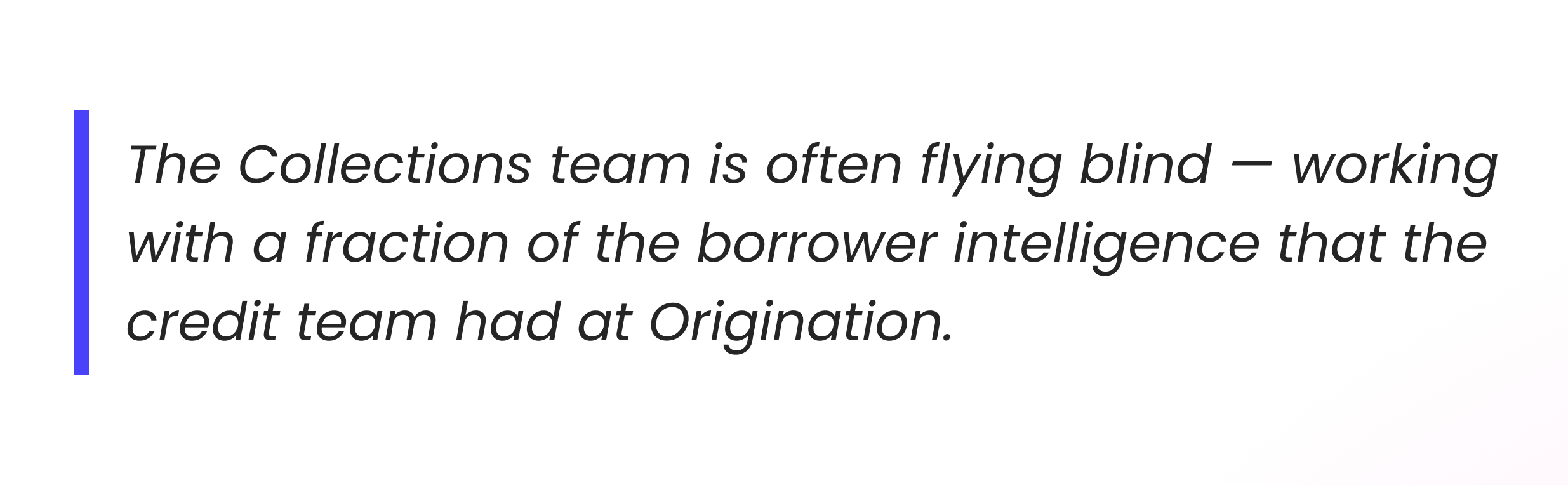
So the collections team is working with a fraction of the borrower intelligence that the credit team had. Loan data lives in one place, borrower risk intelligence lives somewhere else.
How real-time portfolio monitoring changes the equation
The shift from reactive to pro-active collections starts with visibility. When an LMS can surface portfolio performance in real time — by cohort, product, geography, disbursement month, or risk band — credit and collections leadership can act on trends before they become problems.
Real-time portfolio monitoring enables three things that legacy systems typically can't deliver:-
– Predictive flagging: Identifying accounts that show early behavioural signals of stress before they miss a payment, enabling pre-emptive outreach.
– Dynamic collections prioritisation: Automatically ranking collections queues by recovery probability, expected loss, and borrower engagement score rather than simply by DPD bucket.
– Restructuring Automation: Triggering restructuring eligibility assessments when defined criteria are met, reducing the time between stress identification and resolution.
For an NBFC running a portfolio of even a few thousand crores, the difference between a 2% gross NPA and a 3.5% gross NPA can be the difference between profitability and capital erosion. The interventions that prevent that drift are mostly operational, not origination-led.
What a Modern LMS should do: A Checklist for NBFCs
If you're evaluating your existing Loan Management System — or considering a platform migration — here are the capabilities that separate a Modern LMS from a glorified ledger:
– Automated early warning system with configurable triggers at multiple DPD thresholds
– Integrated borrower communication workflows (SMS, WhatsApp, IVR, email) with delivery and response tracking
– Role-based collections queues with prioritisation logic built in
– One-click restructuring with configurable approval workflows and automated re-amortisation
– Real-time dashboards at portfolio, cohort, product, and branch levels
– Native integration with the Loan Origination System to carry Origination data through the loan lifecycle
– Audit-ready reporting for RBI inspections, covering all servicing actions and communications
– Co-Lending portfolio management — tracking performance by partner lender with separate waterfall logic
If your current Loan Management System requires manual intervention for more than three of these , it's a liability — not just an operational inconvenience, but a direct contributor to credit losses.

One platform, Full Lifecycle: AllCloud's approach
AllCloud was built on a single foundational belief: That separating Origination from Servicing creates information gaps that cost lenders money. The platform covers the full Lending Lifecycle — LOS, LMS, Collections, Co-Lending, and Analytics —in a single unified system, so borrower intelligence captured at underwriting is available to every team at every stage of the loan's life.
That means collections officers have complete origination context. Portfolio analytics feed directly into underwriting policy calibration. Restructuring workflows are configurable without engineering support. And Co-Lending portfolios are managed within the same system, without reconciliation nightmares across disconnected platforms.
For NBFCs serious about NPA management, the question isn't whether to fix the credit model. It's whether the platform managing the loan after disbursement is actually working for you — or silently against you.
.svg)