.png)


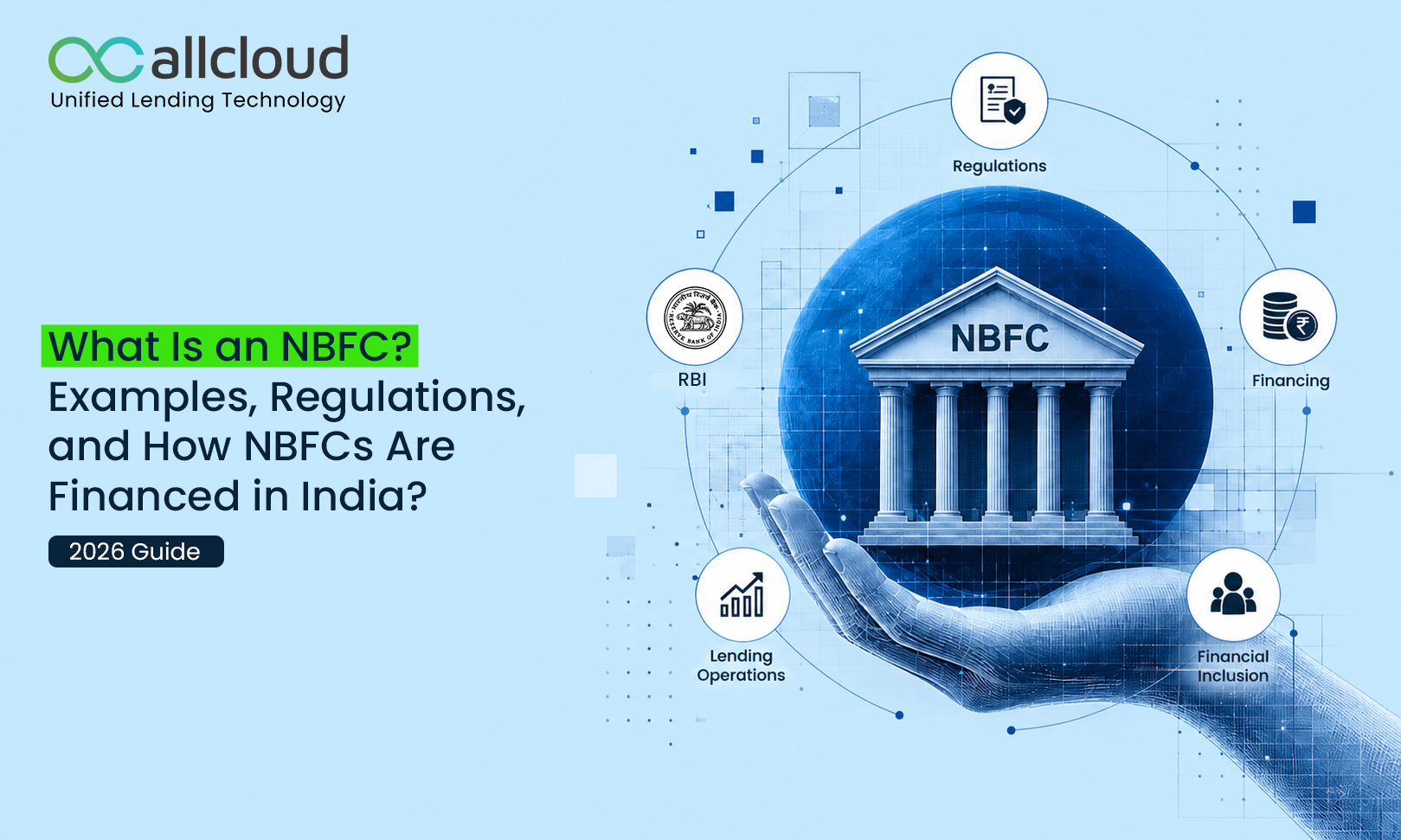
What Is an NBFC? Examples, Regulations, and How NBFCs Are Financed in India [2026 Guide]

Get In Touch
Heading 1
Heading 2
Heading 3
Heading 4
Heading 5
Heading 6
Lorem ipsum dolor sit amet, consectetur adipiscing elit, sed do eiusmod tempor incididunt ut labore et dolore magna aliqua. Ut enim ad minim veniam, quis nostrud exercitation ullamco laboris nisi ut aliquip ex ea commodo consequat. Duis aute irure dolor in reprehenderit in voluptate velit esse cillum dolore eu fugiat nulla pariatur.
Block quote
Ordered list
- Item 1
- Item 2
- Item 3
Unordered list
- Item A
- Item B
- Item C
Bold text
Emphasis
Superscript
Subscript
If you work anywhere near Indian lending as a founder, an operator, or someone evaluating where to put capital you'll run into the term "NBFC" constantly. But the details underneath that one acronym (what counts as an NBFC, how safe they are, how they're funded, whether they're "fintechs") tend to stay fuzzy even for people inside the industry. This guide clears that up in one place.
What Is an NBFC?
A Non-Banking Financial Company (NBFC) is a company registered under the Companies Act that carries out lending and financial activities but without holding a banking license. NBFCs are regulated by the Reserve Bank of India (RBI), subject to capital adequacy norms, asset classification rules, and periodic inspection broadly the same regulatory philosophy applied to banks, with differences in scope and flexibility.
What actually runs underneath an NBFC's operations is, increasingly, software: a platform handling loan origination, underwriting, disbursement, collections, accounting, and RBI compliance reporting in one place. We cover what that looks like in detail in our NBFC software guide but the regulatory and structural basics below are worth understanding first.
What Are Some Common NBFC Examples?
NBFCs aren't one uniform category. In India, common examples include:
- Asset finance companies- vehicle and equipment loans
- Microfinance institutions (NBFC-MFIs)- small-ticket loans to low-income borrowers, often group-lending models
- Housing finance companies- home loans and loans against property
- Gold loan NBFCs- lending against gold jewellery as collateral
- Infrastructure finance companies- long-term funding for infrastructure projects
- Investment and loan companies- general lending and investment activity under an NBFC license
Each category sits under slightly different RBI norms capital requirements, exposure limits, and reporting formats all vary by type. That's part of why generic accounting software tends to fall short for NBFCs: the compliance and workflow requirements are category-specific, not one-size-fits-all.
When Did NBFCs Start in India?
The regulatory framework for NBFCs traces back to the Reserve Bank of India (Amendment) Act, with the RBI assuming defined regulatory authority over NBFCs from the early 1960s. The sector's real growth, though, came from the 1990s onward, as financial sector liberalization expanded credit access into segments MSME lending, microfinance, vehicle finance where traditional banks historically had lighter penetration. That regulatory evolution hasn't stopped: RBI reporting formats and compliance expectations continue to shift periodically, which is one reason NBFCs need software that's actively maintained against current requirements, not built once and left alone.
Is It Safe to Borrow From an NBFC?
For borrowers: RBI-registered NBFCs are legally recognized lending institutions, subject to the same general regulatory oversight philosophy as banks. Before transacting with any NBFC, it's worth verifying its RBI registration number publicly searchable on the RBI's website since unregistered or fraudulent lenders sometimes use "NBFC" branding without authorization. For NBFC operators, "safety" extends further into operational and data security. A compliant lending platform should provide role-based access controls, encrypted storage of borrower KYC and financial data, full audit logs of loan-file changes, and automated backups. This is as much a software question as a regulatory one.
Are NBFCs the Same as Fintech Companies?
Not exactly, but the line has blurred considerably. An NBFC is a regulatory category a licensed, RBI-registered lending entity. "Fintech" describes a technology approach to delivering financial services. In practice, many fintech lenders operate by partnering with or becoming licensed NBFCs themselves (since lending in India generally requires an NBFC license or a bank partnership), while many traditional NBFCs have modernized into fintech-style operations digital onboarding, APIbased credit decisioning, cloud lending software while retaining the license that makes lending legally possible in the first place.
How Are NBFCs Financed? Can They Access Bank Funding?
NBFCs typically fund their lending operations through a mix of:
- Equity capital from promoters and institutional or private investors
- Term loans and working capital lines from banks
- Debt market instruments- non-convertible debentures (NCDs) and commercial paper
- Securitization- selling pools of existing loans to free up capital for new lending
- Co-lending arrangements with banks under RBI's co-lending model framework, where a bank and an NBFC jointly originate and fund loans
That last point answers a question we hear often: yes, NBFCs can and do access bank funding directly, and co-lending in particular has become a significant channel in recent years. One operational note worth flagging banks and co-lending partners increasingly expect clean, auditable, loan-level data from their NBFC partners. That's far easier to produce from a structured digital lending platform than from manual records, and it's becoming a real factor in which NBFCs can access these partnerships at all.
Why Does the NBFC Sector Sometimes See Stock or Performance Volatility?
This is a markets and macroeconomic question more than an operational one. NBFC stock or sector performance can soften for reasons unrelated to any individual company's day-to-day operations broader liquidity tightening, rising borrowing costs, asset-quality concerns following a credit cycle, or regulatory tightening on specific loan categories have all driven sector-wide pressure at different points. If you're researching a specific NBFC's stock movement, that's a question for financial disclosures and market news rather than a general explainer.
What is within an individual NBFC's control during periods of sector stress is operational efficiency tighter underwriting, faster collections, lower cost-to-serve. All three are directly shaped by the quality of the loan management software running underneath the business which is the connecting thread across almost every question in this guide.
FAQ
What is an NBFC in simple terms?
An NBFC is a company registered with and regulated by the RBI that lends money and provides other financial services without holding a banking license.
What are some real examples of NBFCs in India?
Vehicle finance companies, microfinance institutions, housing finance companies, gold loan lenders, and infrastructure finance companies are all common NBFC categories operating in India.
Is it safe to take a loan from an NBFC?
Yes, provided the NBFC is registered with the RBI always verify the registration number before borrowing from any lender.
Are all fintech lenders technically NBFCs?
Many are, or partner with one lending in India generally requires an NBFC license or a bank tie-up, regardless of how "fintech" the front-end experience looks.
Can NBFCs borrow from banks?
Yes through term loans, working capital lines, and increasingly through co-lending partnerships under RBI's co-lending framework.


.svg)