.png)
Beyond Gold: How Lenders Can Grow with Alternative Collaterals

Get In Touch

Heading 1
Heading 2
Heading 3
Heading 4
Heading 5
Heading 6
Lorem ipsum dolor sit amet, consectetur adipiscing elit, sed do eiusmod tempor incididunt ut labore et dolore magna aliqua. Ut enim ad minim veniam, quis nostrud exercitation ullamco laboris nisi ut aliquip ex ea commodo consequat. Duis aute irure dolor in reprehenderit in voluptate velit esse cillum dolore eu fugiat nulla pariatur.
Block quote
Ordered list
- Item 1
- Item 2
- Item 3
Unordered list
- Item A
- Item B
- Item C
Bold text
Emphasis
Superscript
Subscript
Why lenders are looking beyond gold and silver
Gold loans built India’s small-ticket secured lending market, and silver is now joining it under RBI’s framework for lending against gold and silver collateral. But households hold wealth in more places than jewellery. Mutual fund units, fixed deposits and life insurance policies are some of the most common financial assets people already own, and most of them sit untouched even when the owner needs cash.
For lenders, these assets are attractive collateral. Their value is documented, often priced daily or confirmed by an institution, and the borrower has a strong reason to repay: nobody wants to lose a long-held investment. For customers, the appeal is simple. They get liquidity without selling, breaking or surrendering something they meant to keep.
This guide covers three additional collaterals, how each one works, what lenders should plan for, and where this segment could go next for lenders.
Additional collaterals at a glance

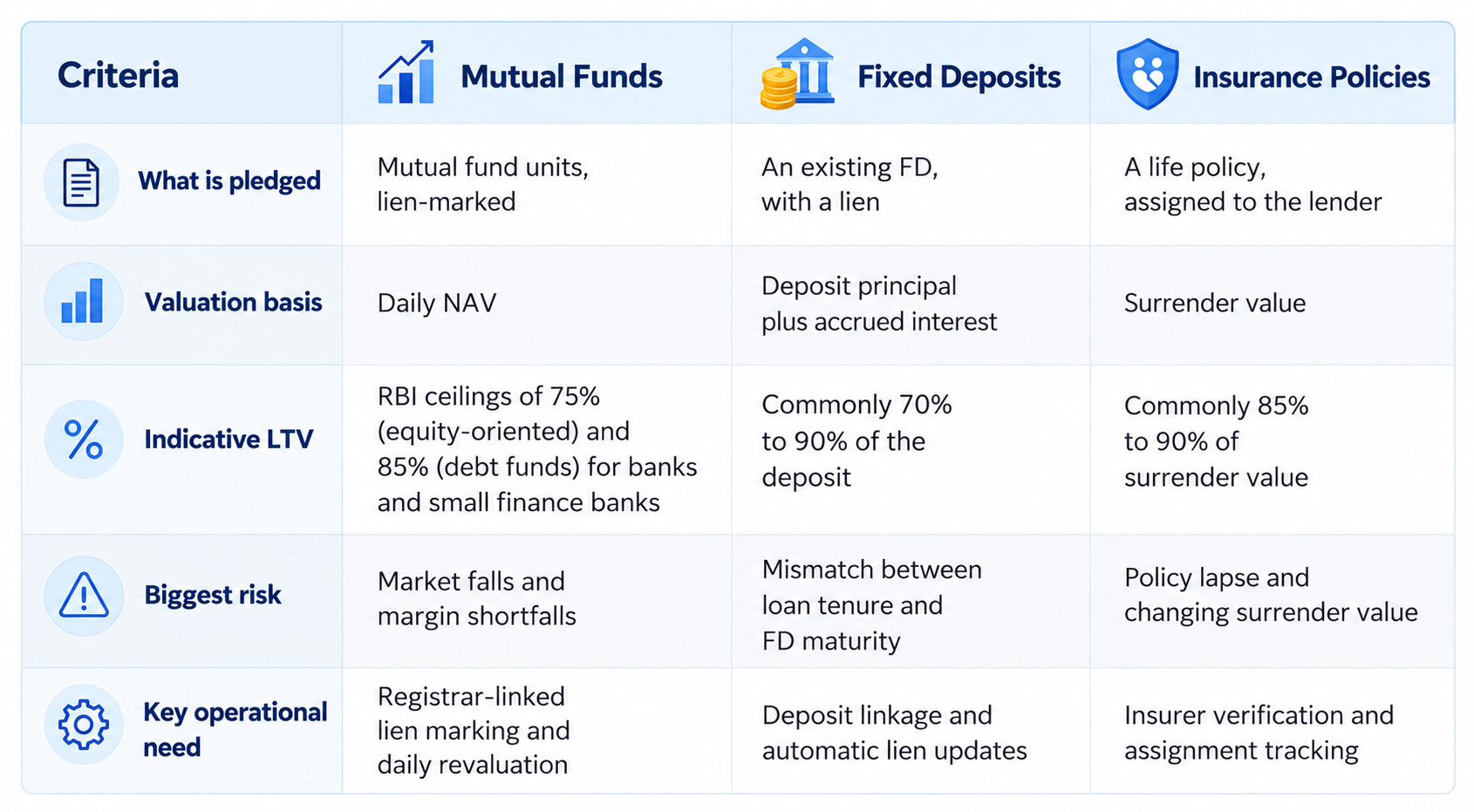
1. Loan against mutual funds (LAMF)
Millions of Indian investors hold mutual funds they don’t want to sell. A loan against mutual funds lets them borrow against those units while the investment stays in place. The units are lien-marked, so they can’t be sold or redeemed, but they continue to belong to the investor. Because the collateral is marked to market daily, lenders can underwrite quickly, often without a heavy credit process.
What the RBI rules say. RBI’s 2026 directions on loans against securities set these ceilings for banks and small finance banks:
- Mutual funds (excluding debt funds), ETFs and REIT/InvIT units: maximum LTV of 75%. Debt mutual funds: 85%.
- Loans against eligible securities are limited to ₹1 crore per individual borrower. Coverage suggests this limit applies to non-debt instruments and not to debt mutual funds, which follow the lender’s own board-approved policy.
- The aggregate ₹1 crore cap across lenders was pushed from April 1 to July 1, 2026.
- Lenders’ policies must define collateral selection, concentration limits, haircuts, ongoing valuation and margin calls.
- Loans against securities under lock-in, such as ELSS during the lock-in period, are not permitted.
Why lenders are adding LAMF:
- Lower risk. Collateral is liquid and priced daily.
- Fast, digital journeys. Pledge and disbursal can happen in minutes using registrar-linked lien marking.
- Sticky customers. A borrower with a pledged portfolio is easier to cross-sell to.
- Reasonable yields. Rates quoted by comparison sites for equity funds run roughly 9% to 13% a year, with lower rates for debt funds. Check these against your own pricing.
What demands automation:
- Fetching the investor’s holdings and verifying them with the registrars (CAMS, KFintech).
- Marking and releasing liens on the exact units.
- Applying the correct LTV by scheme category, with haircuts.
- Revaluing daily and flagging margin shortfalls.
- Enforcing the per-borrower cap across all securities-backed borrowing.
- Handling partial releases, top-ups and closures cleanly.
Manual spreadsheets can’t keep up with daily NAV movements across thousands of pledges.
2. Loan against fixed deposit
Breaking a fixed deposit early means a penalty and lost interest. A loan against FD gives customers liquidity without that cost. The borrower pledges an existing deposit as collateral and receives a loan or overdraft against it. The deposit continues to earn interest, and the lender places a lien on it until the loan is repaid. Many such facilities are offered as an overdraft, so the customer pays interest only on the amount used.
Typical terms. Terms vary by lender, but comparison sites report that:
- Borrowers can usually get 70% to 90% of the FD value, with rates around 1% to 2% above the FD rate.
- Some bank offerings are quoted at up to 90% of the deposit. NBFCs are generally quoted at lower LTV and a wider spread.
- The loan tenure generally cannot exceed the FD’s maturity, and the loan is repaid before or at maturity.
These are indicative figures for illustration. Each lender sets its own terms.
Why lenders offer FD-backed loans:
- Minimal credit risk. The collateral is a deposit the lender often already holds.
- Fast turnaround. Processing can be straight-through and sometimes fully digital.
- Customer retention. Customers keep their deposits with you instead of redeeming them.
- Strong for first-time borrowers. It builds a credit history for people with thin files.
Where operations get complicated:
- Linking the loan to the right deposit(s), including auto-renewing and cumulative FDs.
- Maintaining the lien and updating it if the deposit renews or is partly withdrawn.
- Capping the limit at the allowed percentage of principal and accrued interest.
- Tracking the spread against a changing FD rate.
- Triggering set-off against the deposit on default or maturity.
- Handling joint holders, minors, NRE/NRO and other special accounts.
3. Loan against insurance policy
Many households hold endowment and traditional life policies that have built up real cash value. A loan against an insurance policy lets them borrow against that value instead of surrendering the cover. The policyholder assigns the policy to the lender, and the loan amount is based on the policy’s surrender value, not its sum assured. The policy stays in force, and the assignment is removed once the loan is repaid.
Which policies qualify. Eligibility depends on whether the policy has a surrender value:
- Endowment, whole life and similar savings-linked policies typically qualify, while pure term plans do not because they have no surrender value.
- Treatment of ULIPs is inconsistent across sources and lenders. Some accept them, others don’t. Check each lender’s and insurer’s rules.
- A policy generally needs to have been in force for a minimum period (commonly three years of premiums) before it acquires surrender value.
Typical terms:
- Sanctioned amounts are commonly 85% to 90% of the surrender value. Some lenders quote higher or lower figures.
- Interest rates quoted for insurer policy loans are in the high single to low double digits, for example roughly 9% to 11% for LIC policy loans. Treat these as indicative and verify them with the insurer.
- Insurer-run policy loans typically don’t require a fresh credit check because the loan is secured by the policy.
Why lenders add policy-backed loans:
- Secured by a stable asset with insurer-confirmed value.
- Low default risk, since the policy is a savings asset borrowers want to protect.
- Untapped base. Most households have at least one eligible policy, and few use it as collateral.
- Strong fit for semi-urban and rural customers, where traditional policies are common.
Operational complexity to plan for:
- Verifying policy status, premium payment history and current surrender value with the insurer.
- Recording the assignment or lien correctly.
- Watching for lapse risk. A policy that lapses can erase the collateral.
- Tracking the loan balance against a changing surrender value, since the loan can’t exceed it.
- Handling nominee, maturity and death-claim situations, where claim proceeds are adjusted against the loan.
- Managing documentation across many insurers.
What all additional collaterals have in common
The three products look different, but they share the same operational backbone:
- A collateral record linked to the loan. Units, deposit or policy details must be captured, verified and tied to the right account.
- Lien or assignment management. Every pledge needs a clear mark, release and audit trail.
- Ongoing valuation. Daily NAV, accrued interest or surrender value changes, and the loan-to-value ratio changes with it.
- Triggers and alerts. Margin calls, maturity mismatches and premium dues all need timely action.
- Limits and policy checks. Per-borrower caps, LTV ceilings and eligibility rules must be enforced at origination, not afterwards.
- Reporting. Exposure by collateral type must be easy to report to the board and the regulator.
Lenders that build these capabilities once, and treat collateral as a configurable object rather than a one-off process, will find it far easier to add new products later.
Future scope: where additional collaterals could go next
Silver’s entry shows that RBI is willing to widen what counts as acceptable collateral when valuation, custody and recovery rules are clear. That makes it sensible for lenders to plan for a broader collateral mix over the next few years.
These are likely directions, not certainties:
- More lenders in securities-backed lending. With RBI’s directions on loans against securities in place and digital pledge flows already available, more banks and NBFCs may enter loans against mutual funds.
- FD and insurance loans as retention tools. Customers already understand these products, so lenders may use them to deepen relationships with people who already hold deposits or policies with them.
- Reach beyond the metros. Fixed deposits and traditional insurance policies are widely held in semi-urban and rural households, so lenders with branch or agent networks there may find the best fit.
- Faster, more digital journeys. Registrar-linked lien marking, e-consent and API-based checks of deposits and policies could shorten turnaround from days to minutes.
- Multi-collateral offers. Over time, a borrower could be offered one limit backed by a mix of gold, silver, funds and deposits, as far as the rules allow.
- Regulation will set the pace. LTV ceilings, per-borrower caps and valuation norms can change, so lenders should keep product design configurable and track RBI updates closely.
Getting started with additional collaterals
- Pick the right first product. FD-backed loans are the simplest to launch, mutual funds offer the best digital experience, and insurance-backed loans suit semi-urban and rural reach.
- Check the rules that apply to you. RBI’s securities-backed lending directions were issued for banks and small finance banks. NBFCs should confirm how they apply to their own category before launching.
- Update your credit policy for eligibility, LTV, valuation, margin calls and recovery on each collateral.
- Configure workflows and integrations with registrars, depositories or insurers as needed.
- Pilot, then scale across branches and digital channels.
Planning your next secured lending product? Start with the collateral your customers already hold, pilot it in a few branches, and build from there.
Frequently asked questions
What are additional collaterals in lending?
They are assets other than gold and silver that borrowers can pledge to get a loan, such as mutual fund units, fixed deposits and life insurance policies.
What is the maximum LTV on a loan against mutual funds?
Under the RBI ceilings, 75% for equity-oriented funds and 85% for debt funds, though lenders may set lower limits.
Do investors keep earning returns on pledged mutual fund units?
Yes. Units stay in the investor’s name, but they can’t be redeemed until the lien is released.
Is there a cap on how much one person can borrow against securities?
RBI’s framework has a ₹1 crore per-individual cap for eligible securities other than government and listed debt instruments, and debt mutual funds.
Can I get a loan without breaking my FD?
Yes. A loan or overdraft against the deposit lets you borrow while the FD keeps earning interest.
How much can I borrow against an FD?
Commonly up to 70% to 90% of the deposit value, depending on the lender.
Can I take a loan on a term insurance plan?
Generally no, because pure term plans have no surrender value.
Will my life cover continue during a policy-backed loan?
Usually yes, as long as premiums are paid and the policy stays in force.
What happens if I don’t repay a collateral-backed loan?
The lender can adjust the dues against the collateral as per the loan agreement, for example by invoking the lien on units, setting off against the deposit, or adjusting the policy’s proceeds or surrender value.
.svg)